
O-GlcNAc in Disease
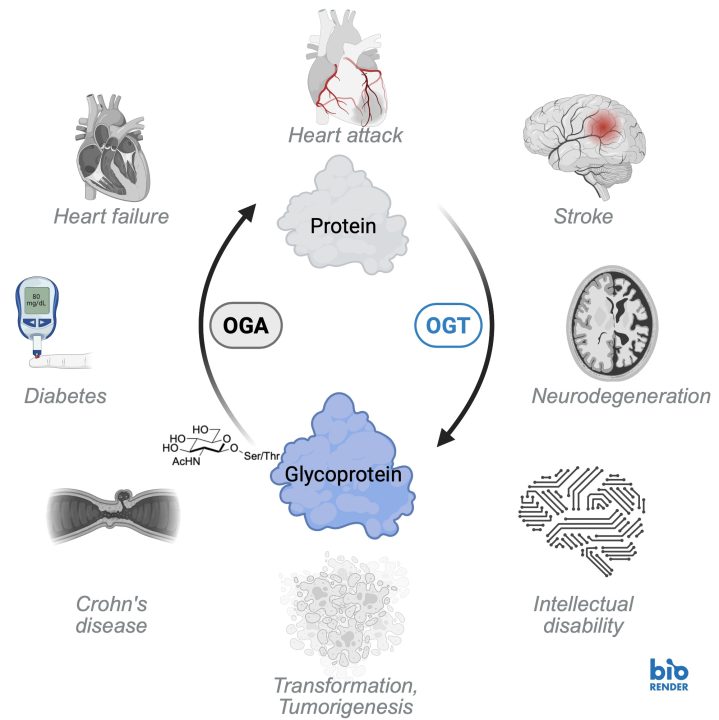
Thousands of nuclear, cytosolic, and mitochondrial proteins are dynamically modified and regulated by monosaccharides of O-linked b-N-acetylglucosamine (O-GlcNAc). Underscoring its importance, O-GlcNAc plays key roles in reproductive health, transformation and tumorigenesis, cardiovascular disease, neurodegeneration, and mammalian development. Our research has established O-GlcNAcylation as a critical regulator of disease mechanisms across multiple organ systems. In collaboration with others, we have demonstrated its role in modulating cardioprotection, atrial fibrillation, and heart failure, revealing both protective and pathological effects depending on context. In cancer, our work showed that O-GlcNAcylation is essential for mutant KRAS-driven lung tumorigenesis and Twist1-mediated suppression of senescence. Collectively, these studies highlight O-GlcNAcylation as a versatile and disease-relevant signaling mechanism with broad therapeutic implications. Our current collaborative work focuses on the impact of O-GlcNAc of Nod2, especially in the context of Crohn’s disease.
Key Citations
Tomar V, Kang J, Lin R, Brant SR, Lazarev M, Tressler C, Glunde K, Zachara N, Melia J. Aberrant N-glycosylation is a therapeutic target in carriers of a common and highly pleiotropic mutation in the manganese transporter ZIP8. bioRxiv [Preprint]. 2024 Jul 2:2024.06.28.601207. doi: 10.1101/2024.06.28.601207. PMID: 39005453; PMCID: PMC11244875.
Lafargue A, Wang H, Chettiar ST, Gajula RP, Shetty AC, Song Y, Simons BW, Khan MA, Nguyen T, Tseng HW, Chang J, Waters DN, Chan A, Lam C, Carrieri FA, Smack C, Connis N, Chowdhury DD, Nugent K, Siddiqui I, Taparra K, Rezaee M, Zachara N, Morris ZS, McFarland C, Abdulkadir SA, Hann CL, Tran PT. Twist1-induced suppression of oncogene-induced senescence in non-small cell lung cancer requires the transactivation domain of Twist1. Neoplasia. 2025 May 22;66:101179. doi: 10.1016/j.neo.2025.101179.
Umapathi P, Mesubi OO, Banerjee PS, Abrol N, Wang Q, Luczak ED, Wu Y, Granger JM, Wei AC, Reyes Gaido OE, Florea L, Talbot CC Jr, Hart GW, Zachara NE, Anderson ME. Excessive O-GlcNAcylation Causes Heart Failure and Sudden Death. Circulation. 2021 Apr 27;143(17):1687-1703. PMID: 33593071.
Mesubi OO, Rokita AG, Abrol N, Wu Y, Chen B, Wang Q, Granger JM, Tucker-Bartley A, Luczak ED, Murphy KR, Umapathi P, Banerjee PS, Boronina TN, Cole RN, Maier LS, Wehrens XH, Pomerantz JL, Song LS, Ahima RS, Hart GW, Zachara NE, Anderson ME. Oxidized CaMKII and O-GlcNAcylation cause increased atrial fibrillation in diabetic mice by distinct mechanisms. J Clin Invest. 2021 Jan 19;131(2):e95747. PMID: 33151911.
Taparra K, Wang H, Malek R, Lafargue A, Barbhuiya MA, Wang X, Simons BW, Ballew M, Nugent K, Groves J, Williams RD, Shiraishi T, Verdone J, Yildirir G, Henry R, Zhang B, Wong J, Wang KK, Nelkin BD, Pienta KJ, Felsher D, Zachara NE*, Tran PT*. O-GlcNAcylation is required for mutant KRAS-induced lung tumorigenesis. J Clin Invest. 2018 Nov 1;128(11):4924-4937. PMID: 30130254.
Hou CW, Mohanan V, Zachara NE, Grimes CL. Identification and biological consequences of the O-GlcNAc modification of the human innate immune receptor, Nod2. Glycobiology. 2016 Jan;26(1):13-8. PMID: 26369908.